
There is no standard funeral
Some families want a full church service with hymns and a burial in the village churchyard. Others want twenty minutes at the crematorium and a pub afterwards. Both are exactly right, if they're right for the person who died.
We don't work from a template. What we do is listen first, explain the options plainly, and then arrange it properly. You will never be hurried, and you will never be sold anything.
Burial or cremation
For some families, the decision has already been made, whether through faith, instructions left in a will, or conversations held long before the need arose. For others, it can be the first difficult decision they face after a bereavement, and they may be unsure where to begin.
That's perfectly okay. If you're unsure, we'll take the time to explain both options clearly. We'll discuss what each involves, the likely costs, and what happens afterwards, including the choices available for ashes. We'll answer any questions you have and help you understand the differences, but the decision will always remain yours. There is no right or wrong choice, only the one that feels most appropriate for your loved one and your family.
Where services are held
We arrange services wherever the person belonged. The churches families choose most often are All Saints, Durrington, St Mary and St Melor, Amesbury, Amesbury Methodist Church and Christ the King, the Roman Catholic church in Amesbury.
Photographs used with the permission of Amesbury Parish Church and the Avon River Team.
Where cremations take place
Most cremations we arrange are at Salisbury Crematorium, Charlton Park Crematorium at Andover, or Basingstoke Crematorium. We know all three well — the staff, the timings, and how to make a service there feel unhurried rather than processed.
Salisbury Crematorium is run by Salisbury City Council. Photographs of Salisbury Crematorium used with their permission.
A cremation without a service, from £1,595
More families are choosing this than used to, for different reasons. Some because the person who died asked for it and didn't want any fuss. Some because the family are scattered and would rather gather properly later, in their own time. Some because it's what they can afford, which is a perfectly good reason and not one anybody should feel awkward about.
It doesn't mean there's no goodbye. Plenty of families hold something of their own afterwards — at home, at a favourite place, months later when everyone can be there.
If you'd like to be there
Our attended direct cremation lets two people be present at the crematorium at 8:30am, for an attendance fee of £100 extra. It sits between a direct cremation and a full service, and many families don't know it exists.
Caring for someone before the funeral
They're brought to us in our own private ambulance and looked after in appropriate facilities at our premises.
You are welcome to visit. There is a chapel of rest at Amesbury, which is where families visit, and another at Salisbury we can open for you by arrangement. It is somewhere you can sit quietly with the person who died, for as long as you want, and it is not a formality — a good number of families find it the most important part of the whole process.
Embalming — what it is, and why we always ask
Not everyone wants it, and it isn't compulsory. But it's worth understanding rather than avoiding.
After someone dies there are natural changes. Embalming slows those changes, which means you can visit up to the day of the funeral, and it gives relatives travelling from a distance the time to get here. For some families that's the difference between saying goodbye and not.
We'll explain what it involves if you want to know, and we won't be offended if you'd rather we didn't do it.
Embalming is carried out here, at our own premises, by a qualified embalmer who works with us. The person who has died does not leave our care at any point, and is not taken somewhere else and brought back.
The vehicles are our own
The hearse and the limousines that carry a family on the day are ours, as is the private ambulance that brings someone into our care. Not every funeral director can say that; many hire in the cars, and the people who drive them, from a carriage master.
Ours are our own, kept and maintained by us, and driven by our own people. It means we control how they look and how they are handled on the day, rather than hoping a contractor gets it right.
Woodland and natural burial
Where the grave is part of a working woodland rather than a churchyard. Most of the natural burials we arrange are at Michael’s Wood Natural Burial Ground at Cholderton — fifteen acres of woodland on an organic farm estate, planted in the 1880s.
The coffin, casket or urn has to be biodegradable, usually recycled paper, wicker or willow. Instead of a headstone, graves are marked with a flat Portland stone, a laser-etched wooden plaque or a simple wooden cross, and families are encouraged to plant a memorial tree, wildflowers or bulbs. All faiths are welcome, plots can be chosen or reserved in advance, and ashes can be interred or scattered there as well.
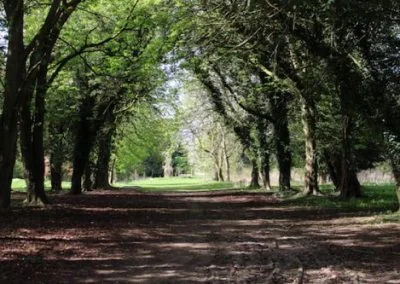
The avenue through the wood 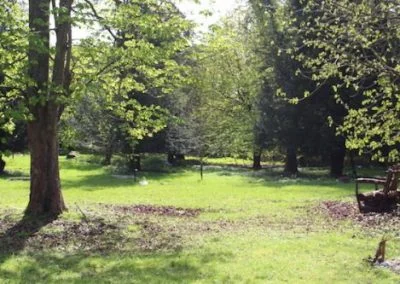
Open ground within the wood 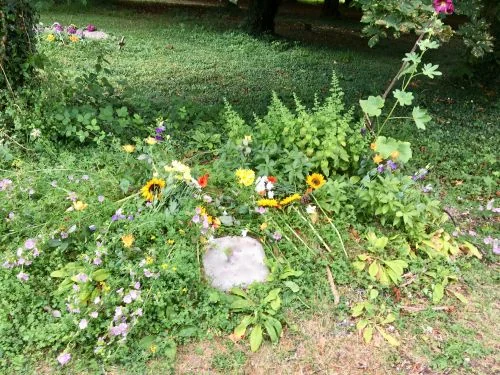
A grave marked with a flat stone 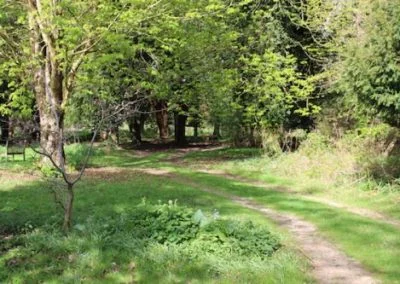
Paths through the newer planting 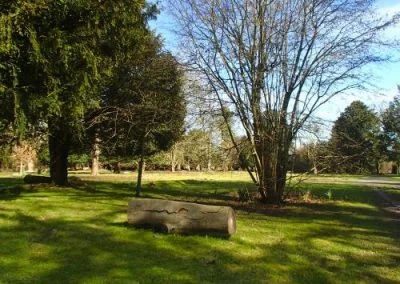
A carved bench in the open ground
Photographs of Michael’s Wood used with the permission of Woodland Burials Cholderton.
Worth being findable
Services outside a church or crematorium
Graveside services, and services in a hall or another place that meant something. We've held a great many at the Wyndham Hall in Amesbury.
Military and service funerals
With Bulford, Larkhill and Tidworth on our doorstep, we've arranged funerals for serving and former service personnel and can assist with what the process involves.
Non-religious and humanist services
Led by a celebrant rather than a minister, built entirely around the person's life.
Horse-drawn and motorcycle hearses
And most other things families ask for. We've arranged a great many.
Funerals further afield
If the person who died wanted to be buried where they grew up, distance is not the obstacle it sounds. Beyond twenty miles there is a mileage charge of £1.50 a mile, which we'll tell you about before anything is agreed.
Repatriation
Bringing someone home from abroad, or taking them home to another country. It isn't something we do often, but we can assist with the process.
What you can choose from
Coffins and caskets, urns and scatter tubes, funeral flowers from the Salisbury Flower Shed, and memorials by Spire Memorials.
Most families arrive with no idea what the choices are, which is entirely normal — it isn't something anyone has thought about before. There's a page where you can look at them quietly, at home, before you sit down with us.
We don't do everything in-house, and we think that's the right way round. Flowers and memorial masonry come from local people we've worked with for years and would use ourselves — and there's no obligation to use either. If you'd rather arrange your own, or a family member wants to do the flowers, we'll work around it.
For the gathering afterwards, tell us roughly what you have in mind and we'll point you at somewhere suitable.
What it costs
Everything we charge is published in full on this website, and you can read it before you speak to anyone.
If money is a worry, tell us at the start rather than the end. It's one of the most common worries there is, and there is usually more that can be done than families expect.
Before you ring
What happens to the ashes?
After a cremation the ashes come back to us, and you can collect them whenever you are ready. Most families take months to decide what to do, and that is perfectly normal.
You can keep them, bury them, scatter them somewhere that mattered, or divide them between family — and we can supply urns, caskets and scatter tubes if you would like one. We hold ashes for five years, free of charge. If we have not heard from you in that time we will try to reach you at least nine times and keep a record of each attempt, and only if we have had no reply at all would the ashes be scattered at the crematorium once the five years are up. In practice that almost never happens. If you need longer, just tell us.
Do I have to have embalming?
No, it isn't compulsory and not every family wants it. It slows the natural changes after death, which means you can visit up to the day of the funeral and relatives travelling from a distance have time to get here. We'll explain what it involves if you'd like to know.
Can we have a service somewhere other than a church or crematorium?
Yes. Graveside services are common, and we've held many at the Wyndham Hall in Amesbury and in other places that mattered to the person. Tell us what you have in mind.
Can I visit before the funeral?
Yes. There is a chapel of rest at Amesbury, and another at Salisbury we can open by arrangement, and it is somewhere you can sit quietly for as long as you want. Ring first so we can make sure everything is ready for you.